 C1
Luthira Himsara
Geometry validation

Help us understand how this website is used. You can choose essential storage only. Privacy information
A NEW DIMENSION IN PRIMARY EDUCATION
Create. Explore. Learn.
From a child’s geometric net to a solid in their world. From a movement in the air to a letter they know. Meet GeoLex AR.
Illustrative playback. This visual explains the concept, rather than running the research application.


WATCH OUR RESEARCH COME TO LIFE
Explore our research, the ideas behind it
and the learning experiences we created.
THE LEARNING CHALLENGE
A flat net doesn’t immediately reveal a cube. A finished letter doesn’t show how it was formed.
GeoLex AR connects learner-generated input with targeted feedback and 3D or augmented-reality reinforcement. It helps make spatial relationships, movement and object-word connections inspectable.
Understand the research problem →TWO PATHWAYS. ONE INTERACTION APPROACH.
Different ages. Different learning tasks.
Specialized processing for each component.
Construct nets, understand geometric faults and inspect the parts inside a solid.
Explore camera-based letter trajectories and sketch-driven vocabulary activities.
THE FOUR COMPONENTS
Learners construct a geometric net. Shape-specific rules check its mathematical validity before a solid appears in 3D and AR.
Luthira HimsaraFault-specific guidance helps explain an invalid net. Once a solid is ready, virtual slicing makes its internal structure and fractions visible.
 Malitha De Costa
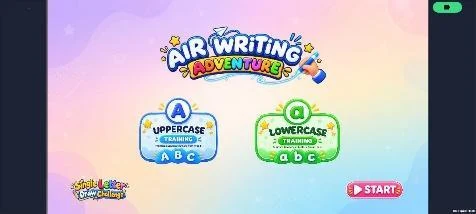
The mobile camera tracks a fingertip moving through free space. An ordered trajectory becomes the input to CNN-based letter recognition.
 Thushad Abhilash
A learner’s sketch becomes an object-word connection. Spelling and pronunciation-oriented activities unlock its corresponding AR representation.
 Navoda Wickramasinghe
HOW THE SUITE WORKS
A shared interaction architecture.
Four component-specific approaches.
A net, a slicing action, an air-written trajectory or an object sketch.
Shape-specific rules or a specialized recognition pipeline.
Correction, recognition or progression guidance that fits the task.
Inspect a 3D solid or unlock an AR representation.
The four components do not use a single shared recognition model.
EARLY RESEARCH EVIDENCE
The pilot involved 50 unique learners across two age groups. Each result measures a different task.
Read the findings and limitations →C1 validity agreement20 valid and 5 invalid evaluated cases
C3 correct letter recognition19/25 trials · 17 uppercase targets sampled
Marks in each pre/post meanDescriptive change on a ten-mark scale
INSIDE THE RESEARCH APPLICATION
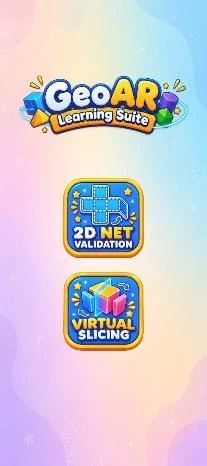
Actual interface images from the supplied
research manuscript, page 5, Figure 5.
The Unity application connects component navigation, feedback, 3D assets and AR presentation. These manuscript screenshots retain the application’s original GeoAR naming.
GeoLex AR is the current public-facing identity.
Explore the workflows →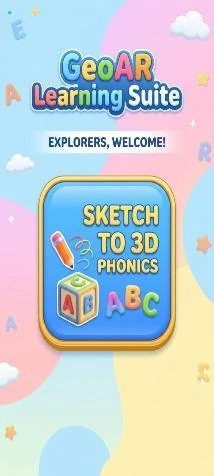
THE PEOPLE BEHIND GEOLEX AR
C1Geometry validation
C2Group Leader · Correction & slicing
C3Air-writing trajectory tracking
C4Multisensory vocabulary learning
LET’S EXPLORE WHAT’S NEXT
Start a conversation about a demonstration, school pilot or research partnership.